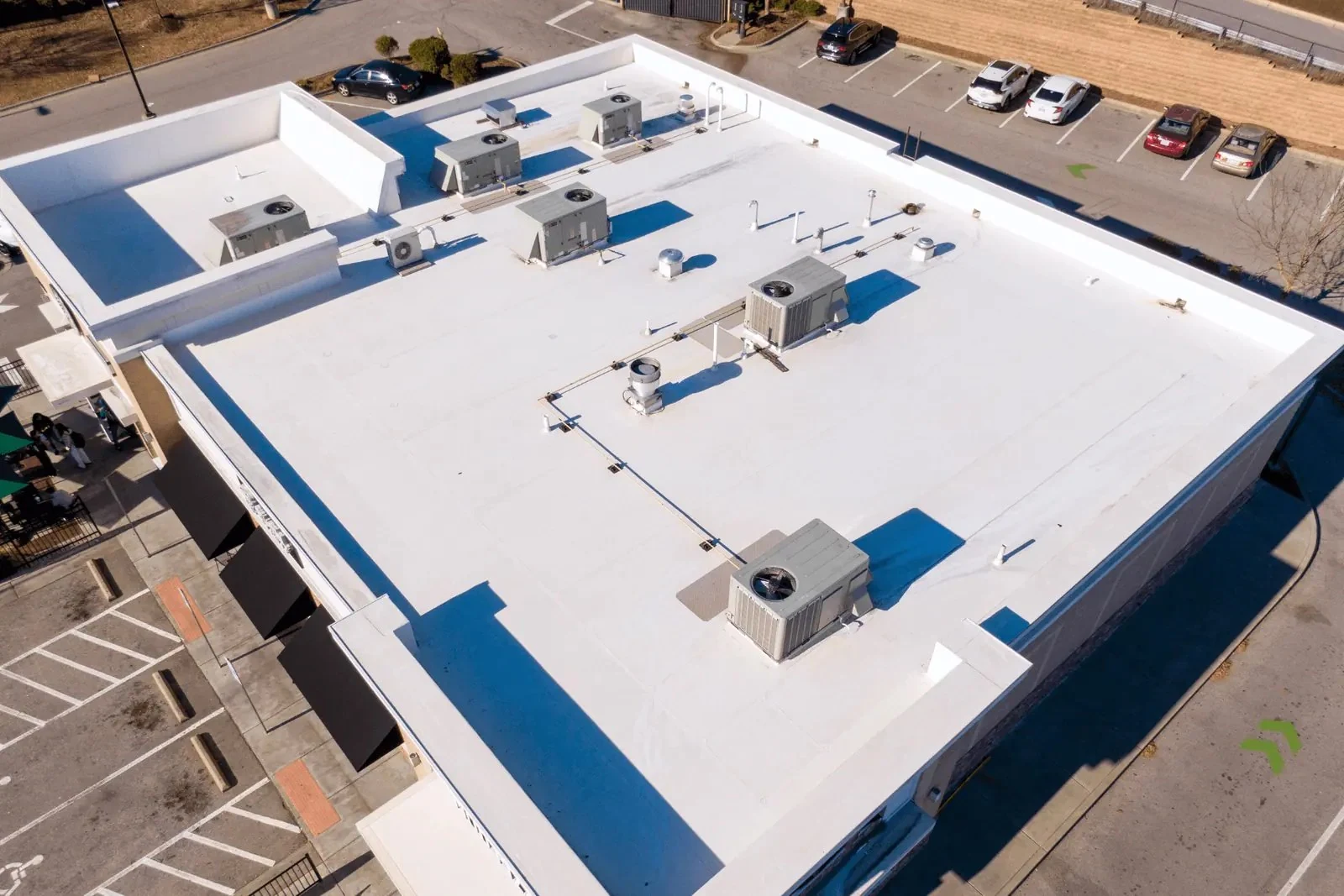
Roof Systems
Spray Polyurethane Foam Roofing in Spartanburg, SC
SPF: A Joint-Free, Slope-Forming System for Irregular Roofs
Spray polyurethane foam, or SPF, is the system we bring up when a Spartanburg County roof has an irregular shape, poor drainage geometry, or a substrate where seamed membrane systems create more transitions and detail work than the building justifies. It's fundamentally different from every other system on this site: SPF is sprayed in place, forms its own insulation and slope, and then gets a protective coating over the cured foam rather than being installed as a pre-manufactured sheet.
How SPF Roofing Actually Works
Two liquid components, an isocyanate and a polyol resin, are mixed and sprayed together, expanding on contact with the substrate to form a closed-cell foam that cures within seconds. That foam layer provides both insulation value and, because the applicator can vary spray thickness across the roof, the ability to build positive drainage slope into a roof that previously had none, correcting ponding water problems that are difficult to solve with a flat membrane system alone. Because the foam bonds directly and continuously to the substrate rather than being installed as discrete sheets, there are no field seams for water to find, which is a meaningful difference from every welded or taped membrane system covered elsewhere on this site.
Why Slope-Forming Matters on Older Buildings
A meaningful share of Spartanburg County's older mill and warehouse conversions were built with minimal or no designed roof slope, which creates chronic ponding that shortens the service life of whatever membrane sits on top. SPF's ability to add tapered insulation value directly through spray thickness, rather than requiring a separate tapered insulation board installation, is one of the main reasons we bring it into the conversation on buildings around Arcadia, Clifton, and other legacy mill sites with flat, aging roof decks. On some of these buildings the roof deck itself has settled unevenly over decades, and SPF's field-applied nature lets the crew correct for that unevenness in ways a factory-cut tapered board layout cannot always match precisely.
Protective Coating Requirements
Cured SPF is never left exposed. It requires a protective top coating, most commonly silicone or acrylic, applied at a manufacturer-specified thickness to protect the foam from UV degradation and mechanical damage. The coating is what actually weathers and needs periodic recoating over the life of the roof, while the underlying foam, if properly protected, can remain sound for decades. We treat the coating maintenance schedule as a defined, recurring line item in any SPF proposal rather than a one-time installation cost.
Application Conditions and Field Control
SPF application is highly sensitive to temperature, humidity, wind, and substrate moisture at the time of spraying, since the chemical reaction and cure quality depend on conditions matching the manufacturer's application window. Spartanburg's humid summer air and afternoon storm patterns narrow the practical application window on many projects, and we schedule SPF work around forecasted humidity and dew point conditions rather than treating it like membrane installation that tolerates a wider weather range.
- Confirm substrate moisture content is within spec before any foam application begins
- Vary spray thickness deliberately to correct ponding and build positive drainage slope
- Apply protective silicone or acrylic top coat at the manufacturer's specified thickness
- Schedule application around humidity and dew point windows in addition to temperature
- Establish a recurring recoat schedule as part of the long-term maintenance plan
- Inspect foam density and coating thickness with core samples on larger projects
FM and UL Ratings for SPF Assemblies
SPF roof assemblies carry FM 4470 wind uplift and UL 790 fire classification ratings tested with the specific foam density and coating system combination, similar to membrane assemblies. Foam density affects both structural and fire performance, so substituting a different foam formulation than what was tested can affect the assembly's rated status, which is why we source foam and coating from a single compatible manufacturer system rather than mixing components across suppliers.
Recoat Cycles and Long-Term Cost
SPF roofs are typically maintained on a recoat cycle, often in the 10 to 15 year range depending on coating type and UV exposure, rather than being torn off and replaced the way membrane systems eventually are. Over a multi-decade hold period, that recoat-based maintenance model can produce a lower total cost of ownership than repeated full membrane replacement, which is part of why SPF appeals to owners planning to hold industrial property long term rather than sell within a few years.
Questions on SPF Roofing
Is SPF a good fit for every flat roof?
No. It works best on roofs with irregular geometry, drainage problems, or numerous penetrations where foam's ability to self-flash and self-slope adds real value. A simple rectangular roof with good existing drainage may not need SPF's added cost.
How often does SPF need to be recoated?
Recoat intervals commonly fall in the 10 to 15 year range depending on the coating system and sun exposure, though we set the actual schedule based on periodic inspection findings rather than a fixed calendar alone.
Can SPF be applied over an existing roof?
Often yes, provided the existing substrate is dry and structurally sound, which is one of SPF's advantages over membrane systems that more frequently require tear-off.
Does weather delay SPF projects more than membrane installation?
Yes. SPF application windows are narrower due to humidity and dew point sensitivity, so scheduling around Spartanburg's summer weather patterns takes more planning than membrane work.
Is SPF suitable for roofs with heavy foot traffic?
With the right coating system and, where needed, granule or walkway pad reinforcement, SPF can handle regular service traffic, though we plan reinforcement at known traffic paths during design rather than after installation.
Ready to review the roof scope?
Request a Roof AssessmentCoverage: Spartanburg and Upstate South Carolina
Building types: Manufacturing, logistics, retail, and institutional
Service: Assessment, repair, replacement, maintenance, and coatings
Systems: TPO, PVC, EPDM, metal, modified bitumen, and coatings
Documentation: Scope, warranty, and closeout records
Response: Spartanburg County and nearby Upstate communities