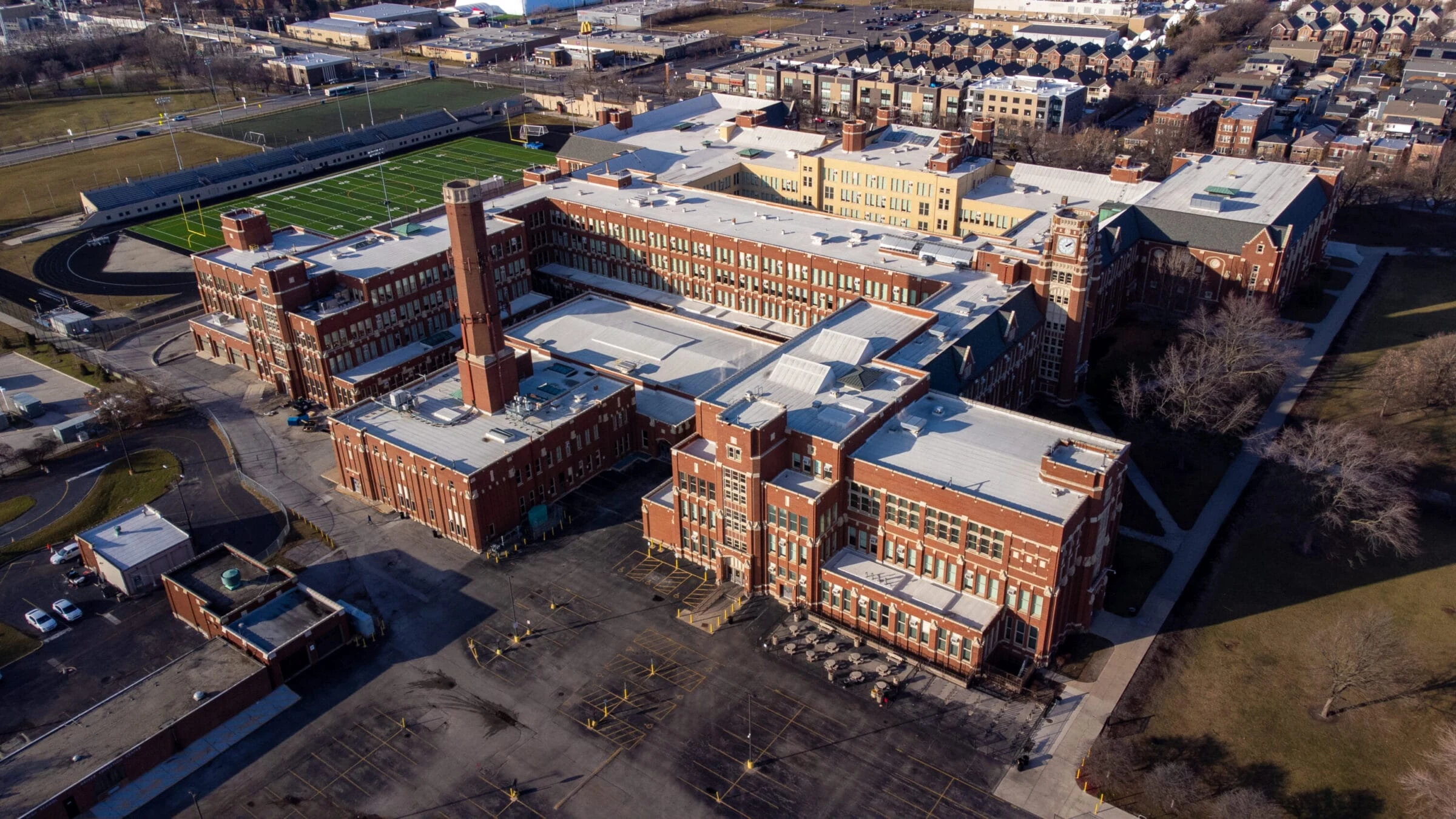
Commercial Project Types
Warehouse Roofing in Spartanburg, SC
Roofing General-Purpose Warehouse Buildings Across Spartanburg County
Not every warehouse in this county is a 500,000 square foot cross-dock building. A large share of our warehouse work is on smaller storage, light-assembly, and third-party logistics buildings scattered through Fairforest, Reidville, and the industrial parks off Highway 29, where ownership and tenant use change more often than the roof does.
Roofs That Outlive Several Tenants
A general-purpose warehouse commonly changes tenant use two or three times before the roof reaches the end of its service life, and each new tenant tends to leave a mark on the roof in the form of a new curb, a satellite dish mount, or a rooftop unit swap. We survey the current condition against what the drawings show rather than assuming the roof matches its original design, since the gap between the two grows with every tenant turnover.
We also note any change in occupancy classification the tenant history suggests, since a warehouse that shifted from pure storage to light assembly or packaging over the years can carry different fire protection and roof penetration requirements than the original building permit assumed.
That survey matters most to landlords quoting a triple-net lease renewal, where an accurate roof condition assessment determines whether a capital improvement gets built into the lease terms or deferred another cycle.
We photograph and log every curb, penetration, and repair patch we find during that survey, dated and located on a roof plan, so the landlord has a real record to compare against the next time the building changes hands or the roof gets surveyed again.
Coordinating Roof Cuts for Tenant Improvements
Tenant improvement projects frequently require new rooftop curbs for exhaust, makeup air, or process equipment, and every one of those cuts is a potential warranty exclusion if it is not coordinated with the existing roof's manufacturer warranty. We require sign-off from the roof manufacturer, or handle the cut and flash ourselves under our own installation standard, before a tenant's mechanical contractor sets a new curb.
We also flag any prior roof cuts we find that were flashed without a permit or manufacturer sign-off, since an improperly flashed cut from a previous tenant is a common source of a leak that gets blamed on the wrong section of the roof entirely.
Racking, Point Loads, and Roof Access
Interior racking systems change the practical access pattern to a warehouse roof from below, and heavy racking near roof supports can concentrate structural load in ways that affect how much added rooftop equipment or solar racking a building can carry. We check structural drawings against current interior racking layout before recommending anything that adds dead load to the roof.
Roof access hatches and ladders also tend to sit above racking aisles rather than open floor space in a warehouse retrofitted for high-density storage, so we confirm safe fall protection and clear staging space at each access point before scheduling crew movement, since a hatch that opens directly above a fully loaded rack aisle is not a safe entry point without additional protection in place.
Recover Economics on an Aging Warehouse Roof
Warehouse owners are usually working against a straightforward return-on-investment question: does a recover buy enough service life to justify deferring full replacement. We pull core samples to check insulation moisture and deck condition before answering that question, since the answer changes completely if the substrate underneath is already wet.
Drainage on Flat, Low-Slope Warehouse Roofs
Many warehouse roofs in this market were built to code-minimum slope, and decades of settling can flatten that slope further in spots, creating ponding that shortens membrane life regardless of how good the membrane itself is. We map ponding areas during survey and specify tapered insulation crickets where the ponding pattern justifies the added cost, rather than treating every recover as a flat re-cover of the existing slope.
Settlement around older dock aprons and loading areas is a common contributor to that flattening, since the structure near a heavily trafficked dock sees more differential movement over time than the interior field. We check dock-adjacent slope separately from the general field for that reason.
- Roof condition survey benchmarked against original drawings, not assumed accuracy
- Tenant improvement roof-cut coordination with existing manufacturer warranty
- Structural load review before adding rooftop equipment or racking
- Core sampling to confirm substrate condition before recover decisions
- Ponding survey and tapered insulation cricket design where needed
- Lease-renewal condition reports formatted for landlord capital planning
Warehouse Roofing Questions
Can you survey our roof before a lease renewal decision?
Yes, we provide a condition report landlords can use directly in capital planning or lease negotiation, based on an actual field survey rather than the original drawings alone.
Who handles roof warranty coordination when a tenant adds equipment?
We coordinate directly with the roof manufacturer or, where we hold the existing warranty, cut and flash the new curb ourselves to keep the warranty intact.
Does interior racking affect what we can add to the roof?
It can. We check structural drawings against current racking layout before recommending added rooftop dead load such as solar racking or new mechanical units.
How do you decide between recover and full replacement?
We pull core samples to check for trapped moisture in the existing insulation and deck. A dry, sound substrate supports a recover; a wet one does not.
Do you fix ponding water on a low-slope warehouse roof?
We map ponding locations during survey and design tapered insulation crickets to correct drainage where the pattern justifies it, rather than re-covering the existing slope as-is.
Ready to review the roof scope?
Request a Roof AssessmentCoverage: Spartanburg and Upstate South Carolina
Building types: Manufacturing, logistics, retail, and institutional
Service: Assessment, repair, replacement, maintenance, and coatings
Systems: TPO, PVC, EPDM, metal, modified bitumen, and coatings
Documentation: Scope, warranty, and closeout records
Response: Spartanburg County and nearby Upstate communities