Industries We Serve
Roofing for Commercial Real Estate and REIT Portfolios
Roof Assessments Built for Portfolio Decisions
Institutional owners and REITs holding industrial or retail assets along the I-85 corridor and around downtown Spartanburg need roof data that supports a capital plan, backed by more than a single repair invoice. We work with asset managers and property teams who need condition assessments, remaining useful life estimates, and budget-ready scope descriptions they can defend to an investment committee.
Condition Assessments for Acquisition and Hold Decisions
Before an acquisition closes or a hold period gets extended, roof condition is one of the line items that affects underwriting. We provide walk-through assessments that document membrane condition, flashing details, drainage adequacy, and estimated remaining service life in terms a due diligence team can use directly, without requiring a roofer to translate the report afterward.
These assessments matter differently depending on asset type. A single-tenant industrial building on a triple-net lease has different roof responsibility questions than a multi-tenant retail center, and we adjust the report to reflect who is actually responsible for what under the specific lease structure your team is evaluating.
Capital Planning Across a Portfolio
Owners managing multiple properties in this market need to sequence roof capital spending across a portfolio rather than treating each building as an isolated decision. We provide budget-level cost estimates broken out by property so an asset manager can prioritize which roofs need attention this fiscal year versus which can be deferred with targeted maintenance for another cycle.
- Condition assessments with documented remaining useful life estimates
- Budget-ready repair versus replacement cost comparisons
- Lease-structure-aware reporting for NNN and multi-tenant assets
- Photo-documented reports formatted for investment committee review
- Preventive maintenance programs to extend asset life between capital cycles
- Coordination with property management on tenant notification and access
Repair Versus Replacement Analysis
A roof nearing the end of its warranty term doesn't automatically need full replacement, and a roof with years left on paper can still have a localized problem that justifies targeted repair instead of a full capital project. We lay out both paths with cost and expected service life for each, so the decision reflects the actual condition of the roof rather than a default toward the largest possible scope.
For assets approaching a planned disposition, we factor holding period into the recommendation. A roof that needs to perform for eighteen more months until a sale doesn't need the same investment as one the owner intends to hold for another decade.
Multi-Tenant and Retail Considerations
Retail centers around Westgate and the downtown corridor carry roof responsibility questions that get complicated with multiple tenants and common area maintenance charges. We document scope in a way that supports CAM billing where applicable, and we coordinate scheduling with property management so tenant operations aren't disrupted by roof work happening overhead during business hours.
Standardized Reporting Across Assets
When a portfolio spans several buildings, consistent report formatting matters for comparison. We use the same assessment structure across every property we survey for a given owner, so a facilities or asset management team can compare buildings apples-to-apples rather than reconciling reports written in different formats by different vendors.
We also flag code or insurance-driven requirements that may apply differently across a portfolio, such as wind uplift ratings that vary by jurisdiction or updated fire code requirements tied to a renovation permit, so nothing surfaces as a surprise mid-project.
Industrial Assets Along the I-85 Corridor
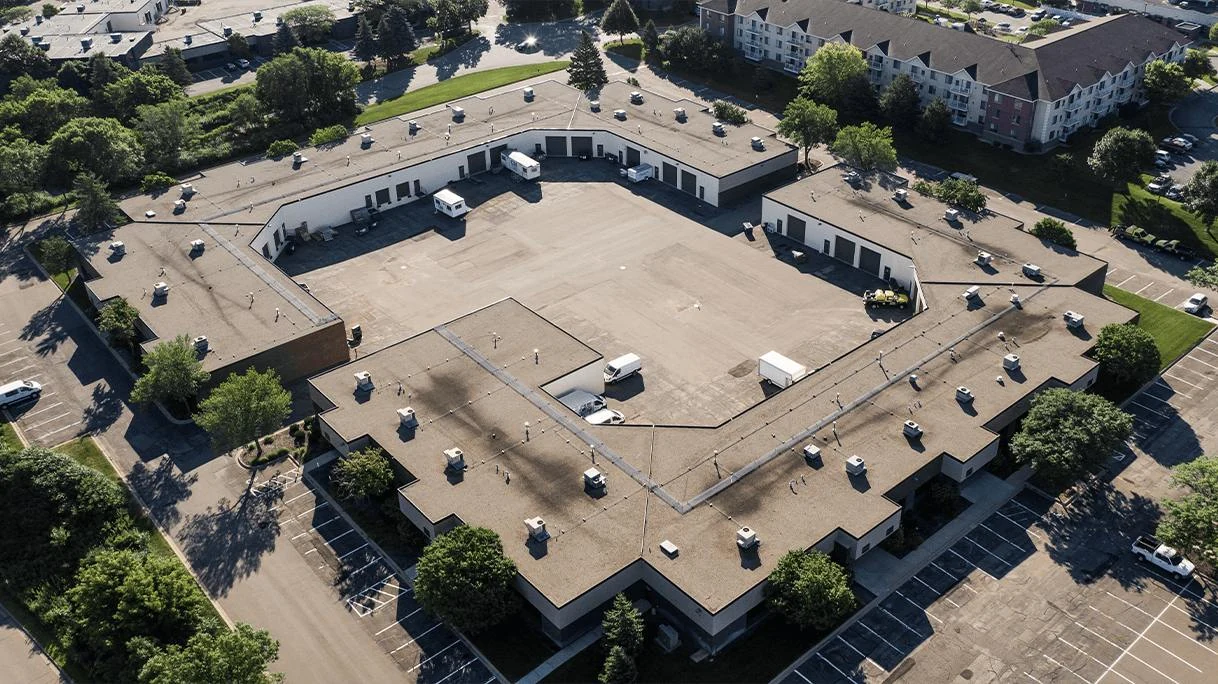
A large share of institutional industrial product in this market sits along the I-85 corridor between Greer and Gaffney, much of it built for automotive suppliers, distribution tenants, or speculative flex space that has since been leased to a logistics operator. These buildings tend to have large low-slope roof plates, and the assessment process for them looks different than for a small retail strip: drainage capacity across a wide roof plate, wind uplift rating relative to the building's exposure category, and tenant-specific rooftop equipment all factor into the condition report.
When we assess a building of this type for a prospective buyer, we also note anything that could affect a future tenant's ability to add rooftop solar, additional HVAC tonnage, or racking-adjacent equipment, since those are common tenant improvement requests in this submarket and roof structural or membrane condition can constrain what's feasible without disclosure at the underwriting stage.
Roof age relative to the manufacturer warranty term is another item institutional buyers ask about directly. A roof with five years left on a twenty-year warranty reads very differently in an underwriting model than one that's already past its rated term and running on borrowed time. We state warranty status plainly in every assessment, along with what documentation exists to support it, since warranty paperwork on older industrial buildings is sometimes incomplete or was never transferred properly at a prior sale.
Common Questions From Asset and Property Managers
Can you provide a roof condition report for an acquisition due diligence package?
Yes. We provide a documented assessment with photos, membrane condition notes, and an estimated remaining useful life, formatted for inclusion in a due diligence file.
How do you handle roof responsibility questions on NNN leases?
We review the lease structure your team provides and scope our recommendation and reporting to reflect who is actually responsible for roof maintenance and capital repairs under that agreement.
Do you provide standardized reports across a multi-property portfolio?
Yes. We use a consistent assessment format across every property we survey for the same owner so reports can be compared directly.
What if the roof only has a short remaining hold period before disposition?
We factor the intended holding period into our recommendation, prioritizing cost-effective repair over full replacement when the roof only needs to perform through a planned sale.
Can you coordinate scheduling around active retail tenants?
Yes. We work with property management to schedule roof work around tenant hours and provide advance notice tenants can use to plan around any noise or access impact, and we can turn a full condition assessment quickly when a transaction or refinancing timeline is tight.
Ready to review the roof scope?
Request a Roof AssessmentCoverage: Spartanburg and Upstate South Carolina
Building types: Manufacturing, logistics, retail, and institutional
Service: Assessment, repair, replacement, maintenance, and coatings
Systems: TPO, PVC, EPDM, metal, modified bitumen, and coatings
Documentation: Scope, warranty, and closeout records
Response: Spartanburg County and nearby Upstate communities